
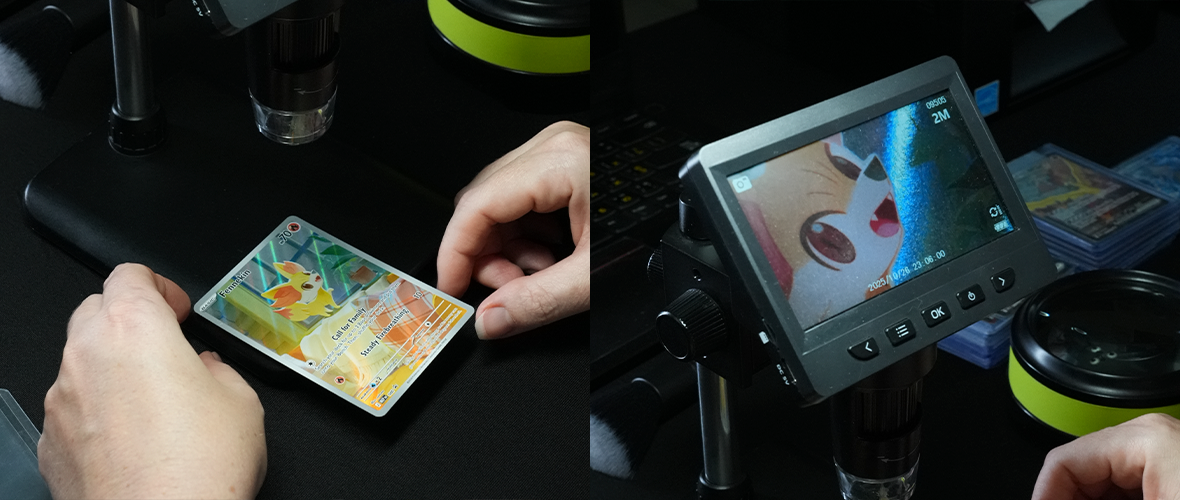
MEGA Card Grading Methodology
The methodology presented here establishes a consistent and transparent grading framework designed to ensure objectivity, repeatability, and uniform application of the MEGA grading standards. It serves as the practical foundation for every grading decision performed within the MEGA Card Grading System.
Every card submitted to MEGA is independently evaluated in four primary grading categories:
- Centering
- Surface
- Corners
- Edges
Each category represents a different aspect of the card's condition and preservation. Every category is assessed independently according to its own grading standard before contributing to the overall evaluation.
Although the four categories are evaluated separately, they should never be considered in isolation. Together they provide a comprehensive assessment of the card's overall state of preservation and collector appeal.

Each of the four grading categories receives an independent numerical sub-grade based upon the official MEGA grading standards.
MEGA applies the internationally recognized 10-point numerical grading scale, beginning with Grade 1 (Poor) and progressing to Grade 10 (Gem Mint). Numerical grades increase in whole-number increments from 1 through 5, followed by half-grade increments from 5 to 10, providing greater grading precision for higher-condition collectibles where relatively small differences in preservation may significantly influence collector value and market perception.
No averaging or balancing occurs during sub-grade assignment.
During grading, each category is evaluated according to the methodology described in its respective grading standard.
The grader shall:
- Identify all relevant characteristics within the category;
- Distinguish manufacturing characteristics from post-production imperfections whenever reasonably possible;
- Evaluate each imperfection according to the MEGA Card Grading Principles;
- Assess both Technical and Visual characteristics;
- Determine the appropriate numerical sub-grade.
Each category is completed independently before the final overall grade is considered.
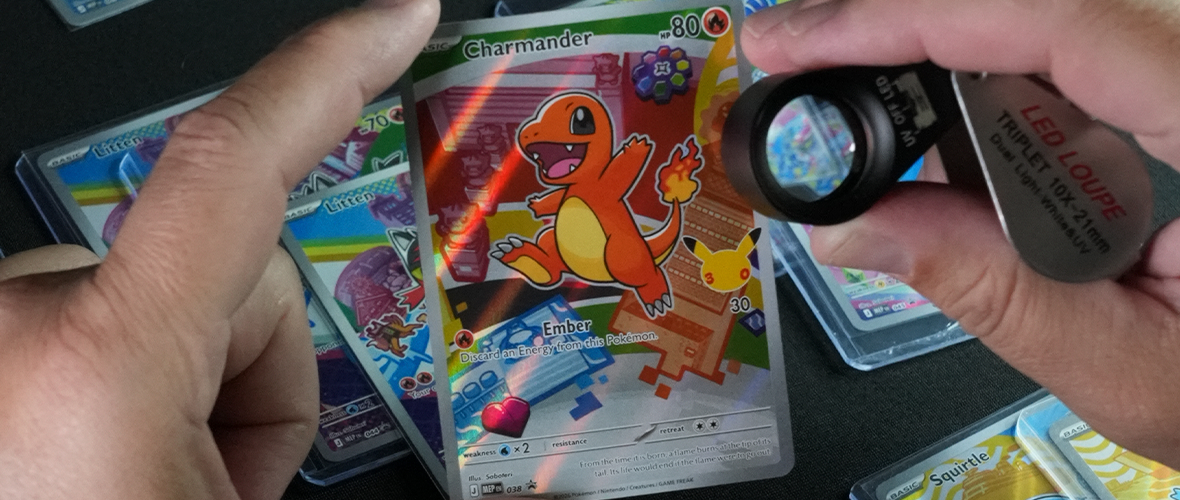
Although grading standards establish objective criteria for every numerical grade, professional judgment remains an essential component of the grading process.
Not every card will correspond perfectly to a single published grading description. Some cards may exhibit characteristics associated with multiple adjacent grades or present unusual combinations of manufacturing characteristics and post-production imperfections.
Professional judgment shall never replace established grading criteria but shall be used to interpret and apply them consistently.
Following completion of all four independent sub-grades, the grader determines the overall numerical grade of the card.
The overall grade is established through a balanced evaluation of Centering, Surface, Corners & Edges.
The assigned grade reflects the collectible's overall state of preservation rather than a mathematical average of the four sub-grades.

The four sub-grades are intended to complement one another rather than compete.
A superior result in one grading category does not automatically compensate for a substantially weaker result in another.
Likewise, a lower sub-grade does not automatically determine the overall numerical grade unless its deficiencies materially influence the collectible's overall preservation or visual presentation in accordance with the MEGA Card Grading Principles.
To maintain card grading consistency, MEGA employs quality assurance procedures designed to verify that published grading standards are applied uniformly.
Quality assurance may include independent review, internal verification, grader consultation, or additional examination whenever necessary to ensure that the assigned grade accurately reflects the card's condition.
